A person may know weekly therapy isn't enough anymore, yet still feel unsure about hospitalization. Symptoms may be disrupting sleep, work, relationships, or basic routines, while the person remains able to spend nights at home. Families often reach this point after a difficult appointment, a worsening week, or a discharge from a more restrictive setting.
Partial hospitalization, or PHP, can fill that missing middle. It offers structured treatment during the day without overnight admission. Understanding the PHP level of care helps adults and families ask better questions about safety, daily functioning, treatment intensity, insurance, and the next step after stabilization.

Table of Contents
- Introduction to PHP Level of Care
- What PHP Means as a Level of Care
- How PHP Compares to IOP Inpatient and Outpatient Care
- Inside a Typical PHP Day and Treatment Approach
- Who Benefits Most and How Eligibility Is Determined
- Insurance Coverage Benefits Verification and Same Day Admission
- Expected Outcomes and Your Next Step Toward Care
Introduction to PHP Level of Care
Consider an adult whose depression has made it difficult to get out of bed, keep up with work, and respond to family members. Weekly therapy provides support, but the long gaps between appointments leave too much room for symptoms to take over. At the same time, the person can remain safe at home overnight and doesn't need continuous hospital supervision.
A PHP gives that person a daily therapeutic anchor. Treatment takes place during the day, with the person returning home afterward. The structure can create enough contact to interrupt worsening symptoms, practice coping skills repeatedly, and identify problems before they become emergencies.
PHP is also useful as a transition. Someone leaving inpatient or residential care may still need substantial support before returning to ordinary outpatient appointments. Others may enter PHP directly because their symptoms and functional difficulties have become too serious for weekly therapy, but their safety needs don't require overnight admission.
Practical rule: The right level of care depends less on the label and more on symptom severity, functional impairment, and safety.
The decision can feel confusing because terms such as PHP, IOP, inpatient, and outpatient describe different amounts of structure. A clear comparison makes the differences easier to understand. A clinical assessment then determines whether the person can safely participate in a day program, needs a less intensive option, or requires more immediate supervision.
For Massachusetts residents, access questions matter just as much as clinical questions. Insurance authorization, network rules, benefits verification, transportation, and step-down planning can affect how quickly care begins. Cedar Hill Behavioral Health in Southborough provides a local point of contact for adults seeking structured mental health treatment and guidance about the admission process.
What PHP Means as a Level of Care
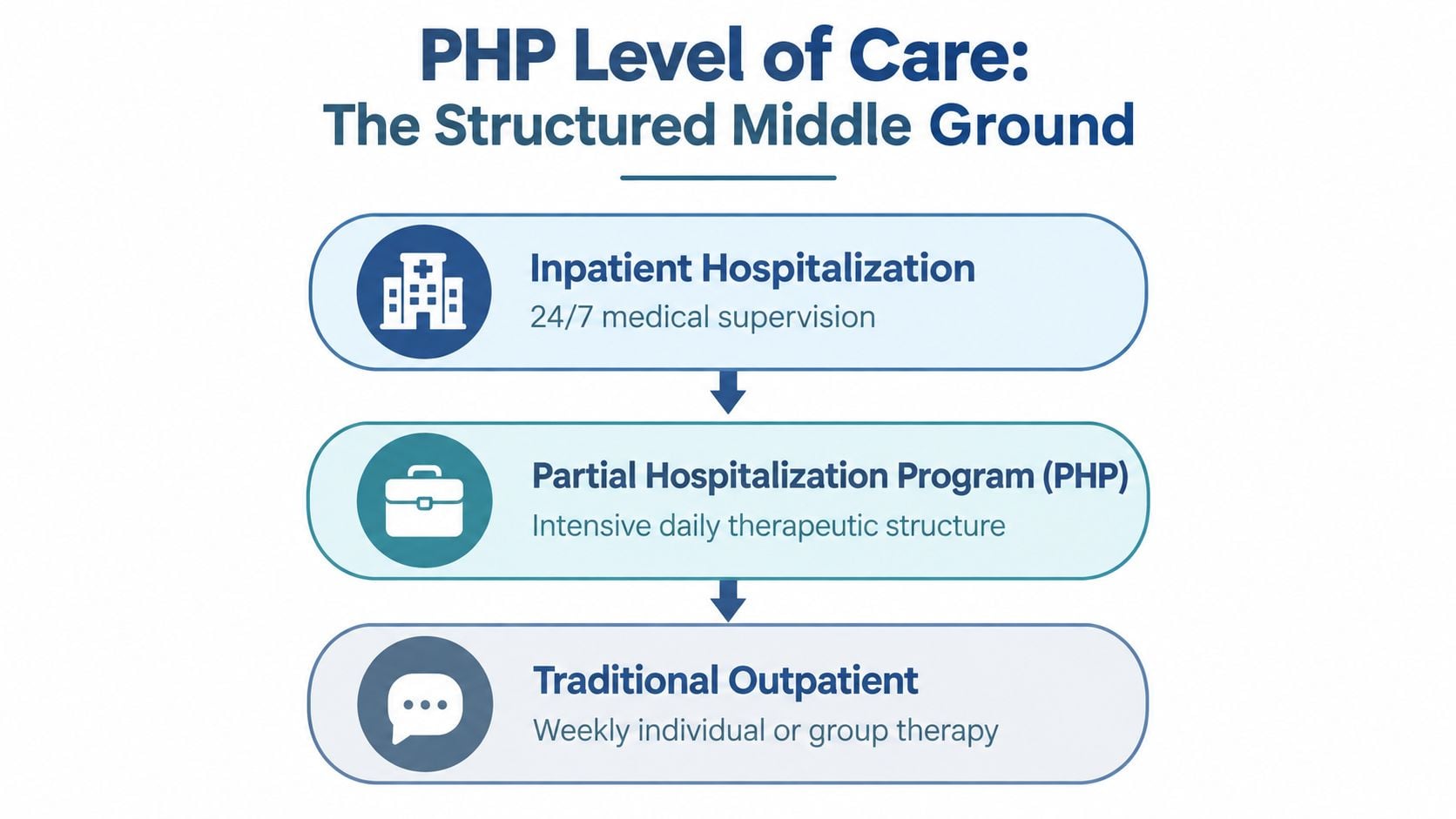
A useful analogy is a bridge. Traditional outpatient therapy may be a short weekly crossing, while inpatient treatment provides continuous supervision. PHP is a structured daytime bridge, giving a person intensive clinical contact while allowing them to sleep at home.
The program isn't residential. A person attends scheduled treatment during the day and returns to a community setting afterward. That arrangement preserves some independence, but it also requires enough stability to remain safe outside program hours.
Intensity has a clinical purpose
PHP isn't "more therapy." A treatment team uses the added structure to stabilize symptoms, monitor changes, teach practical skills, coordinate medication care, and involve family or other supports when appropriate. The schedule may include group therapy, individual work, psychiatric services, medication management, family therapy, education, and skills practice.
Medicare describes outpatient PHP services as usually including four to eight hours of care per day, and beneficiaries may qualify when a care plan identifies a need for at least 20 hours of therapeutic services per week. These standards are explained in Medicare's coverage guidance for outpatient partial hospitalization.
Massachusetts guidance aligns adult Partial Hospitalization Service with the ASAM Level 2.5 model, including a minimum of 20 hours of clinically intensive treatment services per week. The state description includes individual and group counseling, medication management, family therapy, educational groups, occupational and recreational therapy, and direct access to psychiatric, medical, and laboratory services. The Massachusetts terminology and day treatment guidance provides that framework.
PHP is a recognized middle level
PHP has a long history as a middle-intensity behavioral health service. A major review traces the day hospital concept to the early 1930s, describes programs developing in England and Canada around 1946, and notes expansion during the 1950s as an alternative to large mental hospitals. In the United States, Medicare formally recognized PHP as a reimbursable benefit in 1988, with a definition requiring treatment five days per week and six hours per day at that time. The historical review of partial hospitalization explains how the model became a distinct level of care.
Massachusetts also clarified that freestanding PHP and IOP providers are clinic-licensed mental health service entities under 105 CMR 140.000, effective August 27, 2025. The state clarification also says these services don't include a residential component. That distinction helps families understand that PHP is intensive outpatient care, not a place to live. Details appear in the Massachusetts licensing clarification for PHP and IOP services.
How PHP Compares to IOP Inpatient and Outpatient Care
Choosing care requires a practical question: How much structure is needed for safety and meaningful progress right now? A person who can maintain daily responsibilities with added support may fit IOP. Someone whose symptoms are substantially disrupting functioning may need PHP. A person who can't remain safe outside continuous supervision may need inpatient care instead.
The table below separates the levels without treating any category as a permanent identity. Clinical teams may recommend stepping up or down as symptoms change.
PHP vs IOP vs Inpatient vs Outpatient at a Glance
| Level of Care | Typical Hours Per Week | Overnight Stay | Best For |
|---|---|---|---|
| PHP | At least 20 hours in programs following the Massachusetts adult service guidance | No | Moderate-to-severe symptoms requiring intensive daily structure, with sufficient safety for home overnight |
| IOP | Less intensive than PHP, with a schedule determined by the program and clinical plan | No | Symptoms needing more support than weekly therapy while the person can maintain greater daily flexibility |
| Inpatient | Continuous hospital-based care | Yes | Acute safety or medical needs requiring constant supervision |
| Outpatient | Usually scheduled appointments rather than a day-program schedule | No | Symptoms that can be managed with periodic therapy, medication care, or both |
PHP usually sits above IOP in structure and below inpatient care in supervision. IOP may work well when a person can use skills between sessions, return to a stable home environment, and keep enough contact with work, school, or family responsibilities. Standard outpatient care may be appropriate after stabilization, but it can be too limited during an acute period.
The safest choice is the level that matches the person's current needs, not the level that feels easiest to schedule.
Families comparing schedules and expectations can review PHP versus IOP mental health care before speaking with an intake professional. The comparison can help identify useful questions, but it can't replace a clinical assessment.
A person should seek urgent emergency help when immediate safety is uncertain, severe medical complications are present, or home supervision isn't adequate. PHP isn't designed to replace emergency or inpatient care when continuous protection is necessary.
Inside a Typical PHP Day and Treatment Approach
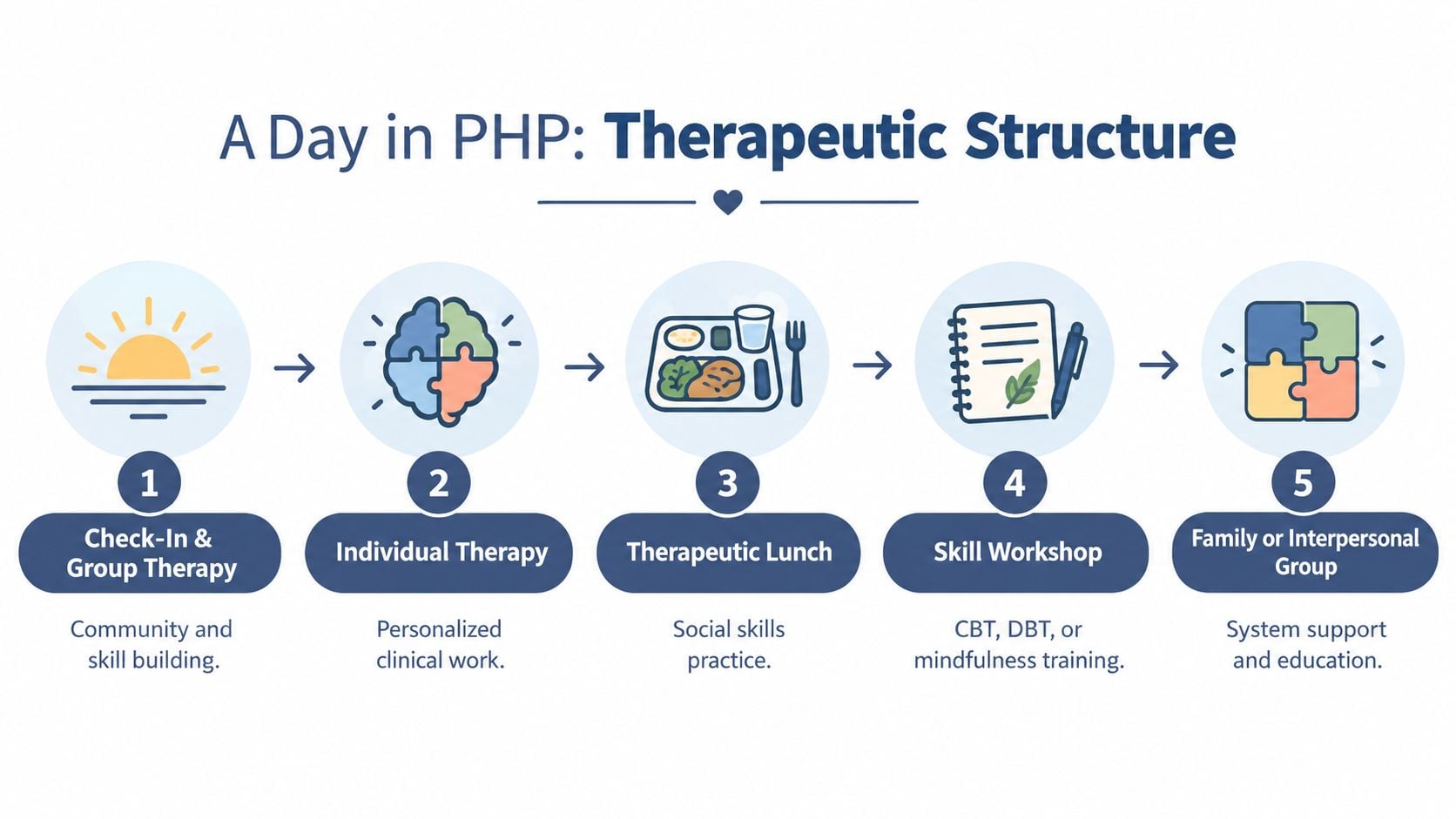
A PHP day is structured on purpose. Predictable transitions reduce unplanned time, give clinicians regular opportunities to observe changes, and help participants practice skills in more than one setting. The exact schedule varies, but the day commonly combines community treatment, individual clinical work, education, medication support, and family or interpersonal care.
A day built around repetition and practice
A participant may begin with a check-in and group therapy. The group gives the treatment team information about mood, sleep, anxiety, urges, or other concerns while helping participants build communication and coping skills.
Individual therapy then focuses on the person's treatment goals. A clinician may examine depressive thinking, panic responses, trauma symptoms, obsessive patterns, mood instability, or relationship conflict. The work becomes more useful when the participant can practice a skill during the same day and discuss what happened afterward.
A therapeutic lunch or shared break can support social skills and routine. It isn't just downtime. Participants may practice eating consistently, tolerating conversation, setting boundaries, or remaining present around other people.
Treatment is individualized
Skills workshops may draw from cognitive behavioral therapy, dialectical behavior therapy, mindfulness, emotion regulation, distress tolerance, or relapse-prevention planning. At Cedar Hill Behavioral Health, the stated approach includes cognitive behavioral therapy and mindfulness alongside individual, group, and family therapy, psychiatric care, and medication management.
Family involvement can clarify how symptoms affect the home and what support will be helpful after program hours. Medication management may address side effects, adherence, symptom changes, and coordination with psychiatric care. When medical or laboratory needs arise, Massachusetts guidance recognizes direct access to psychiatric, medical, and laboratory services within the adult PHP model.
Personalized plans may address anxiety, depression, bipolar disorder, borderline personality disorder, OCD, PTSD, and other mood disorders. The purpose isn't to force every participant through the same sequence. It's to provide enough structure for stabilization while tailoring treatment to the diagnosis, goals, risks, strengths, and home environment.
Who Benefits Most and How Eligibility Is Determined
PHP may fit an adult whose symptoms are too disruptive for weekly therapy but who can remain safe outside program hours. The person may be missing work, withdrawing from family, neglecting daily routines, experiencing severe anxiety, or struggling to manage mood symptoms without frequent professional contact.
A diagnosis alone doesn't determine eligibility. Two people with the same diagnosis may need different levels of care because their functioning, support systems, treatment history, and safety risks differ.
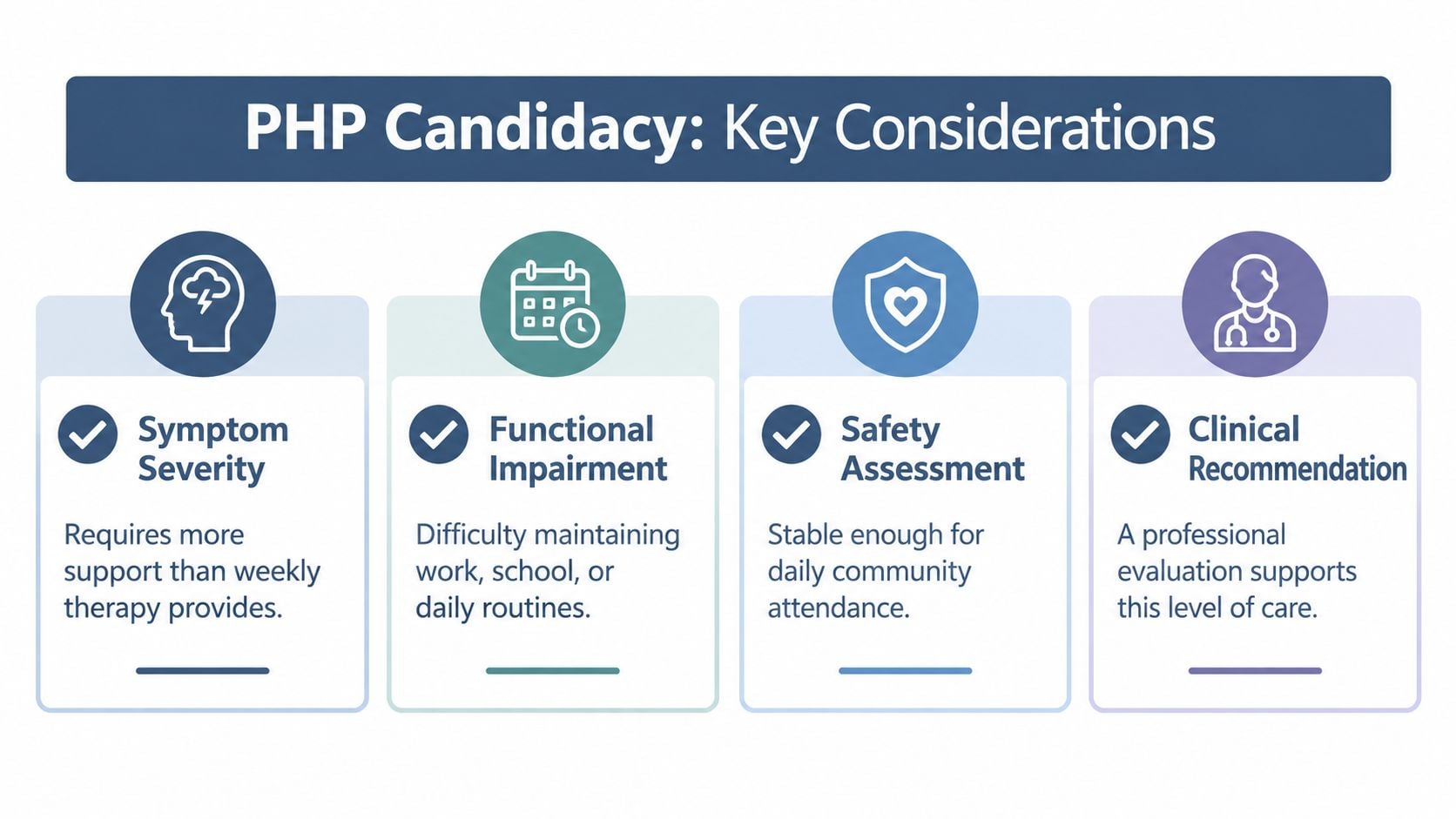
Four questions guide the assessment
Symptom severity: Are symptoms persistent or intense enough that weekly appointments leave too much time without support? A person may need daily therapeutic contact to regain stability.
Functional impairment: Has the condition affected work, school, self-care, sleep, eating, parenting, or relationships? Functional changes often show why a higher level is needed.
Safety: Can the person travel to treatment, participate appropriately, and remain safe at home overnight? If not, inpatient evaluation may be more appropriate.
Clinical recommendation: A licensed mental health or medical professional reviews symptoms, history, medications, risks, supports, and goals before recommending PHP, IOP, outpatient treatment, or a more restrictive setting.
Progress determines what comes next
The American Academy of Child and Adolescent Psychiatry describes PHPs as involving at least 20 hours per week of structured treatment, often five days per week, and typically lasting two to eight weeks in its guidance on partial hospital programs and IOPs. Duration isn't a promise or a deadline. The treatment team reviews progress and determines whether the person should continue, step down to IOP, return to outpatient care, or receive a higher level of support.
An adult or family member preparing for an assessment can write down recent changes in sleep, appetite, work attendance, medication use, panic, mood shifts, self-care, substance use, and safety concerns. The signs that a higher level of care may be needed can help organize that conversation, but professional evaluation remains essential.
Insurance Coverage Benefits Verification and Same Day Admission
Insurance questions often create delays at exactly the moment a person needs help. PHP coverage may depend on the plan, diagnosis, medical necessity review, provider network, authorization requirements, and continued-stay reassessments. A benefits check can clarify eligibility, but it isn't the same as a guarantee of payment.
What verification can clarify
An intake team may help confirm whether the provider participates with the plan, whether PHP is a covered service, what authorization process applies, and whether deductibles, copayments, or other patient responsibilities may apply. Insurance reviewers may request clinical information and reassess the need for continued PHP care. Families should ask how decisions are communicated and what happens if the plan recommends stepping down.
Massachusetts access is developing across public systems. Minnesota's substance use disorder waiver extension described plans to add partial hospitalization services to the state plan in January 2025, while Louisiana legislation in 2025 moved to require reimbursement for partial hospitalization services for adult and geriatric patients. These developments don't mean every plan offers identical access, so direct verification remains important. The Minnesota waiver extension request provides the cited policy context.
Cedar Hill Behavioral Health describes instant benefits verification, acceptance of most major insurance plans, and payment plans for self-pay clients. Families can review the process through free insurance verification for therapy.
Preparing for same-day admission
Cedar Hill Behavioral Health is located at 120 Turnpike Rd., Suite 120, Southborough, Massachusetts and offers same-day admissions when the clinical assessment and logistics support that start. A prospective participant should have identification, insurance information, current medication details, relevant medical records, and emergency contact information available. The intake team can explain what else is needed and whether a PHP schedule is clinically appropriate.
Continuity should be discussed before the first day. A strong plan identifies transportation, evening support, medication coordination, follow-up appointments, and the likely transition to IOP or outpatient care. If immediate safety is uncertain, emergency services are more appropriate than waiting for a routine PHP admission.
Expected Outcomes and Your Next Step Toward Care
PHP can create meaningful improvement without requiring every participant to remain in a hospital. In one comparison of in-person and virtual PHP care, attendance increased from 84.5% to 89.5%, hospitalization declined from 16.5% to 8.9% of discharges, and 74.3% of patients reported that their condition improved. The findings are reported in the published comparison of in-person and virtual PHP care.
Another study of 2,000 patients across two acute PHPs found significant improvement across all four outcome measures, with mean length of stay of 5.3±3.0 days and effect sizes ranging from Cohen d=0.39 to 1.1. The study also found that improvement during one week of PHP was greater than changes during a two-week waiting period, as described in the acute partial hospitalization study.
A systematic review of 18 studies found no differential outcome between partial and full hospitalization for psychopathology, social functioning, family burden, or service utilization, while satisfaction was often better in PHP during the first year after discharge. The systematic review of partial and full hospitalization supports PHP as a viable option for appropriately selected patients.
Progress doesn't end at discharge. The next level may be IOP, standard outpatient therapy, medication follow-up, family support, or another clinically appropriate service. Cedar Hill Behavioral Health provides PHP, IOP, and outpatient options for adults in Massachusetts, with individualized care that may include therapy, psychiatric support, medication management, cognitive behavioral therapy, and mindfulness.
Cedar Hill Behavioral Health offers structured PHP care, IOP, and outpatient treatment for adults who need support matched to symptom severity while living at home. Adults and families seeking prompt guidance about assessment, benefits verification, or same-day admission can visit Cedar Hill Behavioral Health or call (508) 310-4580.