When emotions swing fast, arguments escalate, urges feel stronger than judgment, or a small setback turns into a full collapse, people often start to believe they're failing at life. Families may feel like they're walking on eggshells. Nothing about that pattern means a person is weak or unreachable. It usually means they need a treatment model that is structured enough to handle intense emotions and practical enough to change day-to-day behavior.
That is where DBT therapy interventions can make a real difference. Dialectical Behavior Therapy was developed by psychologist Marsha Linehan in the late 1980s and first showed strong empirical support in a 1991 randomized controlled trial for chronically suicidal and self-injuring women with borderline personality disorder. It has since accumulated evidence across at least eight published, well-controlled randomized clinical trials for BPD and related problems, as summarized by Behavioral Tech's overview of DBT evidence.
People looking for help often need more than reassurance. They need a clear picture of what treatment looks like, what skills they will learn, and how care can fit the severity of what they're facing. Someone struggling with anxiety or depression may also benefit from supportive resources outside formal treatment, such as these coping strategies for anxiety and depression or practical reading on strategies to heal feelings of emptiness when numbness and disconnection are part of the picture.
Table of Contents
- Feeling Overwhelmed? How DBT Can Help You Find Balance
- What Is Dialectical Behavior Therapy
- The Four Core Modules of DBT Skills Training
- Key DBT Interventions and Techniques in Action
- How Cedar Hill Applies DBT Interventions in Massachusetts
- Is DBT Right for You or Your Loved One
- Begin Your Path to Healing with Cedar Hill
Feeling Overwhelmed? How DBT Can Help You Find Balance
A person may wake up intending to have a normal day, then feel flooded by panic, anger, shame, or emptiness before lunch. One difficult text message can trigger hours of spiraling. A conflict with a partner can lead to self-harm urges, substance use, shutting down, or saying things that damage the relationship further.
DBT was built for exactly this kind of suffering. It isn't a vague encouragement to calm down. It is a structured therapy that teaches people how to survive emotional crises, understand their patterns, and respond differently when life gets hard.
Why DBT feels different
Many treatments focus on insight alone. Insight matters, but it often isn't enough when emotions are intense and behavior becomes impulsive. DBT adds a clear system for what to do next.
That system helps people build what DBT calls a life worth living. In practical terms, that means fewer crises, more stable relationships, better follow-through, and a stronger ability to pause before acting on urges.
Practical rule: If emotions repeatedly overpower intentions, treatment needs to teach skills, not just offer support.
What balance actually means
The word balance in DBT doesn't mean being calm all the time. It means learning two truths at once. A person can be doing the best they can and still need to change. Their pain can be valid and their coping strategies can still be hurting them.
That balance is often a relief for clients and families. It reduces blame without lowering the bar for change. Instead of asking, "What's wrong with you?" DBT asks, "What is happening, and what skill fits this moment?"
A person doesn't need to have everything figured out before starting. They only need enough willingness to practice. That is often where hope begins.
What Is Dialectical Behavior Therapy
Dialectical Behavior Therapy is a multimodal, hierarchical treatment system, not a single worksheet, not a few coping tips, and not ordinary talk therapy with a DBT label attached. According to the University of Washington's DBT overview, standard DBT combines weekly individual therapy of about 60 minutes, concurrent skills-group training, between-session phone coaching, and therapist consultation teams. It also prioritizes targets in a strict order: life-threatening behaviors first, then therapy-interfering behaviors, then quality-of-life problems.
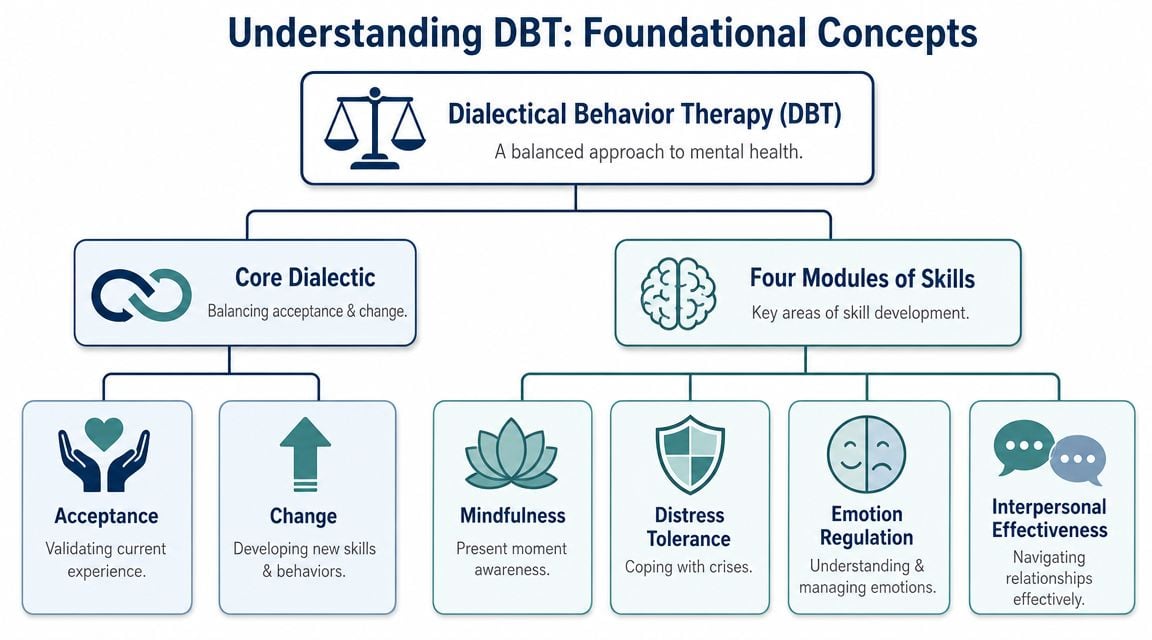
Acceptance and change at the same time
The word dialectical sounds technical, but the idea is simple. Think of it as holding two helpful truths without forcing one to cancel the other.
A client may need acceptance because shame makes change harder. The same client may need change because current behaviors keep creating danger, conflict, or chaos. DBT doesn't ask people to pick one side. It teaches them how to use both.
That matters in treatment. Pure acceptance can turn into stuckness. Pure change can feel harsh and invalidating. DBT aims for a steadier middle path.
What full DBT includes
The DBT approach has several moving parts because different problems require different forms of support.
- Individual therapy helps a person apply DBT to their own life. Sessions target the behaviors causing the most harm and identify where skills broke down.
- Skills training teaches concrete tools for emotion regulation, crisis survival, mindfulness, and relationships.
- Phone coaching helps clients use skills in real time, when the urge to act impulsively is strongest.
- Consultation team supports therapist adherence so treatment stays consistent, focused, and effective.
DBT works best when people understand that it is a full treatment system, not just a coping-skills class.
This structure is one reason DBT is often used with chronic suicidality, self-injury, and severe emotion dysregulation. It is designed to organize treatment under pressure. When a person is overwhelmed, that level of clarity matters.
The Four Core Modules of DBT Skills Training
DBT skills training is the engine of behavior change. These modules aren't abstract ideas. They teach people what to do when they feel flooded, disconnected, reactive, or trapped in repetitive conflict.
Some clients are surprised by how practical the work is. The skills are meant to be used in traffic, at work, after an argument, during cravings, and in those minutes when the nervous system is pushing for a fast, harmful decision.
A practical skills table
| Skill Module | Core Goal | Example Skill |
|---|---|---|
| Mindfulness | Notice the present moment clearly | Observing thoughts without acting on them immediately |
| Distress Tolerance | Get through a crisis without making it worse | Pausing, grounding, and delaying an impulsive action |
| Emotion Regulation | Understand and influence emotional reactions | Identifying vulnerability factors before emotions escalate |
| Interpersonal Effectiveness | Ask for needs, set limits, and protect relationships | Using a clear request instead of escalating or withdrawing |
How the modules show up in daily life
Mindfulness is the foundation. It helps people notice what they feel, think, and want before they react. Without mindfulness, every other skill is harder to use because the person doesn't catch the moment early enough. A simple example is noticing, "My chest is tight, my thoughts are racing, and I want to send an angry text," then pausing before hitting send.
Distress tolerance is for the hard moments that can't be fixed immediately. It answers the question, "What can be done right now so this crisis doesn't get worse?" That might mean using grounding, stepping away from a triggering interaction, or getting through a painful evening without self-harm, substance use, or explosive conflict.
Emotion regulation teaches people to understand how emotions build and what makes them more vulnerable. Lack of sleep, isolation, hunger, shame, and conflict all matter. When clients learn to track those patterns, emotions start to feel less random and more workable. People addressing both addiction and emotional instability often need this link clearly explained, which is why some may also find these Yuba City addiction recovery techniques useful for understanding the role of emotional regulation in lasting change.
Interpersonal effectiveness helps with the moments when someone needs to ask for help, say no, repair conflict, or stop abandoning their own limits to keep the peace. A common example is replacing a vague complaint or shutdown with a direct statement of need and a respectful boundary.
The goal isn't perfect behavior. The goal is a bigger pause between emotion and action.
People often begin by using one skill badly, late, or inconsistently. That still counts as progress. DBT assumes that repetition matters more than perfection.
Key DBT Interventions and Techniques in Action
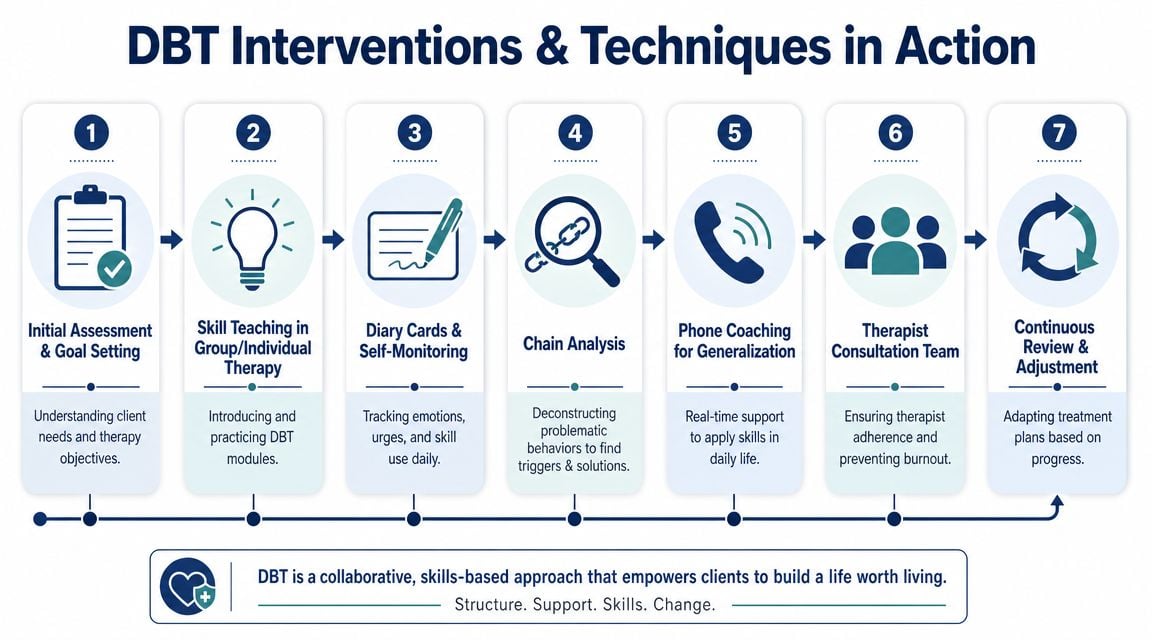
The skills modules tell clients what they are learning. DBT interventions show how therapists help them use those skills when life gets messy.
A good DBT session is active. The therapist's role goes beyond nodding and reflecting. They track patterns, prioritize risk, teach a skill, analyze what happened, and help the client prepare for the next high-risk moment.
What happens between sessions and in session
One core intervention is the diary card. Clients track emotions, urges, target behaviors, and skill use. This isn't busywork. It creates a record of what occurred instead of relying on memory distorted by stress or shame.
Another central intervention is validation. Validation doesn't mean agreeing with every behavior. It means accurately recognizing the person's internal experience so they can stay engaged long enough to change it. When clients feel judged too early, they often shut down or argue. When they feel understood, they can examine behavior more openly.
Phone coaching is another practical feature of DBT. It is designed to help generalize skills to real life. The point is not unlimited reassurance. The point is brief, targeted support so the person can use the right skill in the moment they need it.
A simple chain analysis example
Chain analysis is one of the most useful DBT interventions because it breaks a crisis into links. Instead of labeling a person as self-destructive or impossible, it asks what happened step by step.
A simplified example might look like this:
- Prompting event. A partner doesn't respond to a text.
- Vulnerability factors. The person slept poorly, skipped meals, and already felt rejected.
- Links in the chain. Thoughts shift to "I'm being abandoned." Fear turns into anger. The person checks the phone repeatedly, drinks to numb out, then sends a series of hostile messages.
- Problem behavior. The conflict escalates and the relationship becomes less stable.
- Consequences. Shame increases, trust drops, and the next day feels even worse.
Once the chain is visible, intervention points become visible too.
- Earlier intervention could target sleep, food, or isolation.
- Middle intervention could target thoughts, body arousal, or the urge to act.
- Later intervention could target repair, accountability, and a different response next time.
A chain analysis turns "I don't know why I did it" into "Here are the places where a different skill could have helped."
That shift is powerful. It replaces helplessness with a map.
How Cedar Hill Applies DBT Interventions in Massachusetts
A common Massachusetts scenario looks like this: someone is holding it together just enough to get through work or school, then falling apart at home, in relationships, or during the hours no one sees. Weekly therapy may be too little. Inpatient care may be more than the situation requires. DBT works best when the treatment setting matches the actual level of risk, instability, and day-to-day impairment.
Matching DBT intensity to the level of care
At Cedar Hill, DBT interventions are applied across PHP, IOP, and outpatient care so treatment can fit the person instead of forcing the person to fit one rigid format.
A Partial Hospitalization Program is often the right starting point when emotions are driving repeated crises, daily functioning is slipping, or safety concerns need close attention. The advantage is structure. Clients get frequent practice, repeated coaching from clinicians, and enough contact to catch patterns before they turn into another emergency. The trade-off is time. PHP asks for a larger commitment during the week, which can be hard for families balancing work, transportation, or caregiving responsibilities.
An Intensive Outpatient Program gives many adults a practical middle ground. It offers more support than weekly therapy while allowing clients to keep living at home and continue parts of work, school, or family life. That matters because DBT skills are meant to be used in real situations, not only inside a therapy office. If that level sounds closer to what you need, Cedar Hill's Massachusetts intensive outpatient program explains how structured treatment can support change without a hospital stay.
Outpatient care fits people who are stable enough for less frequent contact but still need steady DBT-based treatment for emotion regulation, relationship conflict, impulsive behaviors, or relapse prevention. For some, outpatient is the starting point. For others, it works best after PHP or IOP, when the goal shifts from crisis reduction to maintaining gains and strengthening daily routines.
Why this level-of-care range matters
Access to DBT is often harder than families expect. Full-model DBT takes trained staff, coordinated programming, and enough clinical coverage to support people through high-risk periods. Programs that already have intensive outpatient infrastructure tend to have an easier time implementing DBT consistently, as described in this review of DBT implementation challenges.
That matters in real life.
A treatment approach can be well supported by research and still be difficult to use if scheduling is limited, the level of care is wrong, or there is no clear path to step up or step down as symptoms change. Cedar Hill addresses that problem by offering PHP, IOP, and outpatient services within one system of care. For clients, that can mean fewer disruptions, clearer treatment planning, and a better chance of keeping momentum when life improves or gets harder.
Families often need support too, especially when self-harm is part of the picture. This guide on helping someone self harming offers practical ways to respond with more steadiness and less panic while your loved one gets treatment.
Is DBT Right for You or Your Loved One
DBT is often a strong fit when emotions feel intense, impulsive behaviors keep causing damage, or repeated crises are making work, school, family life, or relationships unstable.

Who tends to benefit most
DBT has its strongest evidence base for borderline personality disorder and self-harm. A later summary reports a 50% reduction in suicidal behavior and hospitalization rates for participants receiving DBT versus treatment as usual in a 2006 study, and the same review notes DBT's use has expanded to depression, eating disorders, and substance use disorders, with treatment often lasting six months to a year. Those findings are summarized in this published review on DBT outcomes.
It may be worth considering DBT if a person:
- Acts fast under stress and regrets it afterward
- Struggles with self-harm urges or chronic suicidal thinking
- Experiences relationship chaos driven by fear, anger, or shutdown
- Uses substances or other behaviors to escape emotional pain
- Needs structure rather than open-ended supportive therapy alone
Families supporting a loved one with self-harm often need practical guidance alongside treatment. This guide on helping someone self harming may help caregivers respond more calmly and effectively. For those specifically exploring diagnosis-related care, this page on borderline personality disorder treatment options can also provide context.
When another starting point may make more sense
DBT is not always the first intervention to start with. If someone is actively psychotic, severely cognitively impaired, or medically unstable, another level or type of treatment may need to come first. In those situations, stabilization and safety planning usually take priority before full DBT work can begin.
That doesn't mean DBT is ruled out forever. It means treatment sequencing matters.
Begin Your Path to Healing with Cedar Hill
People often come to DBT after trying to cope alone for too long. By that point, many feel ashamed of their reactions and doubtful that real change is possible. DBT offers a different message. Skills can be learned. Patterns can be interrupted. A more stable life can be built step by step.
The most important part is getting the right level of care for the current level of distress. Some people need a highly structured day program. Others need intensive outpatient support or steady outpatient therapy with room to practice new skills over time. Matching treatment intensity to symptom severity often determines whether progress sticks.
For adults and families in Massachusetts, it helps to speak with a program that understands emotion dysregulation, self-harm risk, mood disorders, and the practical barriers that keep people from getting care early. Clear admissions guidance, insurance verification, and fast access can remove some of the friction that keeps treatment delayed.
Healing rarely starts when someone finally feels ready. It usually starts when they reach out while things are still hard.
If DBT therapy interventions sound like the kind of structured support you or your loved one needs, contact Cedar Hill Behavioral Health to talk through next steps, program fit, and admissions options. Compassionate help is available now. Call (508) 310-4580.